The Secret to How to Keep Balcony Plants Alive in a Heatwave — Shade Cloth, Watering Timing and Pot Material
Last summer my west-facing balcony hit 40°C by lunchtime, and I watched healthy basil crisp in a single afternoon. I fixed it without fancy gear: smarter shade, ruthless watering timing, and swapping a few pots. In this guide I’ll show you exactly how to stop heat stress before it starts and keep containers productive through the worst weeks — what to change today, what to buy at a standard garden centre, and how to read your plants so they bounce back fast.
Heat Beats Roots First: Why Balcony Plants Crash in Extreme Sun
Capsule: Container plants fail because pots overheat and dry out faster than roots can drink. Sun on dark pots pushes root-zone temperatures past 35°C, which shuts roots down and scorches leaves even if you water daily. Wind and reflected heat from walls multiply the stress. Treat heatwaves as a root-protection project first, leaf-protection second.
Plants on balconies fail because containers overheat and dry out faster than roots can drink. Sun on dark pots can push root-zone temperatures past 35°C, which shuts roots down and scorches leaves even if you water daily.
Wind and reflected heat from walls and railings multiply the stress. I treat heatwaves as a root-protection project first, and a leaf-protection project second.
| Symptom | Likely Cause | Immediate Fix |
|---|---|---|
| Crispy brown leaf edges | Underwatering or salt burn | Deep soak + flush soil with fresh water |
| Yellowing + wilting despite wet soil | Overwatering or heat-damaged roots | Stop watering, improve drainage, shade the pot |
| Sunburned white/tan patches | Sudden sun exposure | Move to shade; don’t prune damaged leaves yet |
| Midday droop, recovers by evening | Normal heat stress response | Monitor; no action unless droop persists |
| Morning wilt before sun hits | Under-watering or pot too small/hot | Water deeply at dawn; shade or upsize the pot |
Action today: At midday, press your palm to the sunniest pot for five seconds. If it feels hot, your roots are in danger — plan to shade the pot itself, not just the foliage.
Use Shade Cloth Correctly: Angle, Density, and Placement
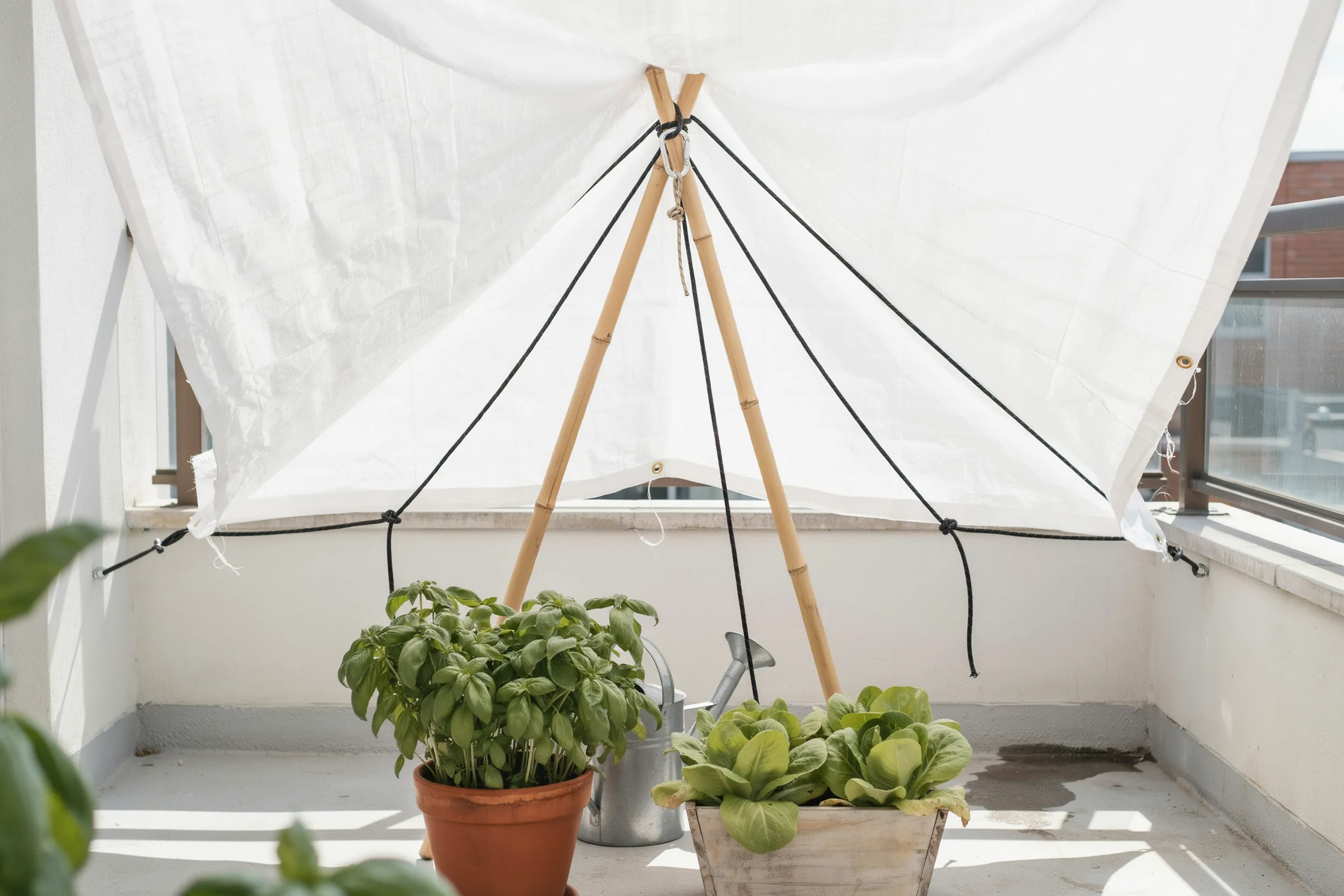
Capsule: Use 30–50% density for sun-tolerant edibles (tomatoes, peppers) and 50–70% for tender herbs and greens (basil, lettuce) during heat spikes. White or reflective cloth outperforms black. Hang it 10–20 cm above foliage with sides open for airflow. Block 11am–4pm sun on west exposures.
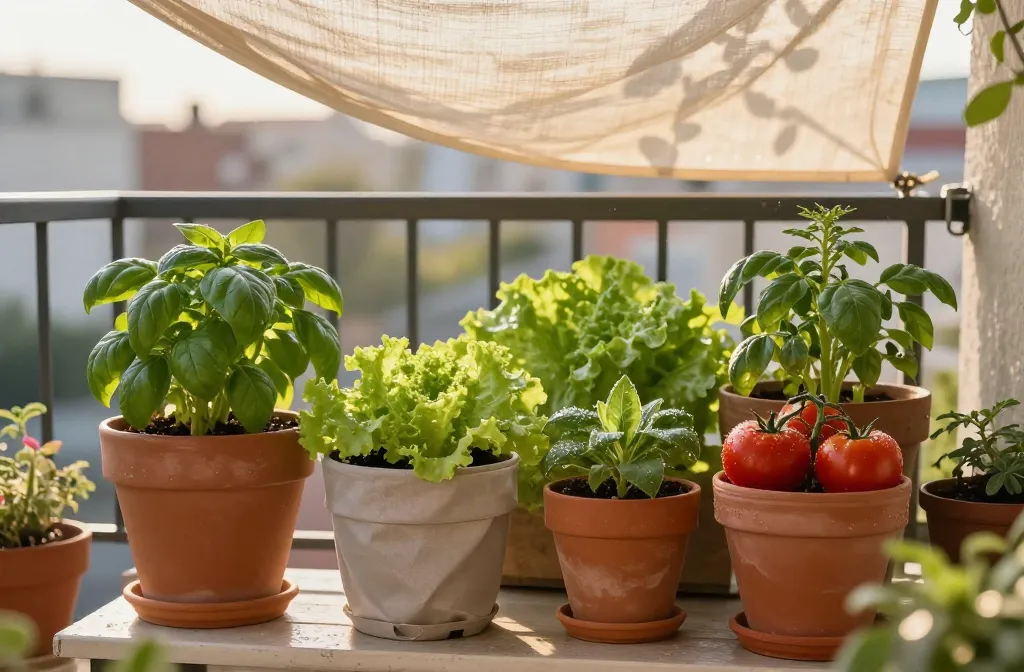
Shade cloth isn’t a blanket; it’s a filter. I use 30–50% density for sun-tolerant edibles (tomatoes, peppers, rosemary) and 50–70% for tender herbs and greens (basil, lettuce, coriander) during heat spikes. Denser than 70% stalls growth. White or aluminet (reflective) shade cloth is superior to black during heatwaves because it reflects solar radiation rather than absorbing it.
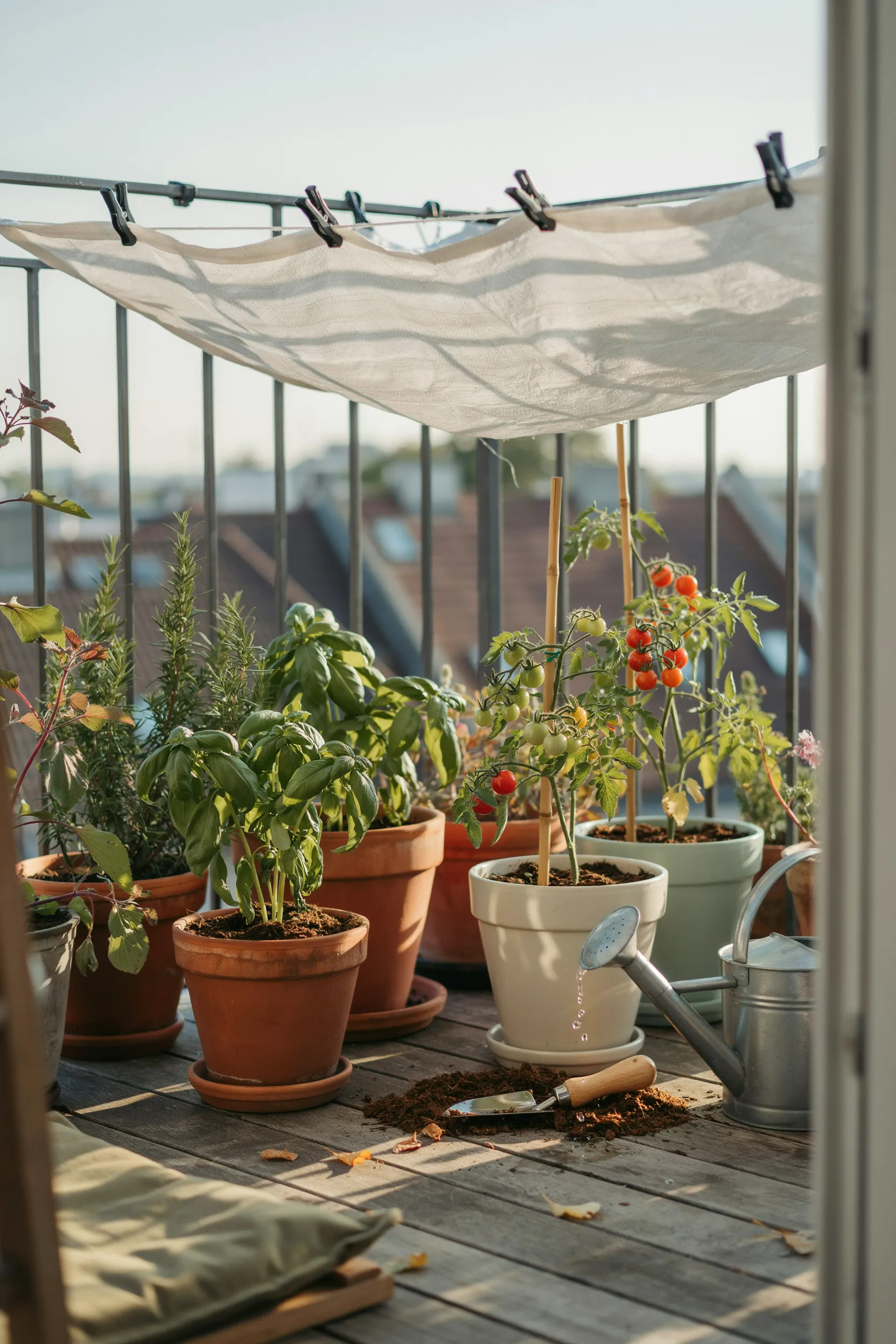
Angle matters. I hang cloth so it blocks the harshest sun window — usually 11am–4pm on west or north-west exposures — while keeping the top and sides open for airflow. A simple bungee cord and zip-tie setup from the hardware store does the job.
Keep the cloth 10–20 cm above foliage to avoid trapping heat. If your railing or wall throws glare, extend cloth slightly past the pot line to shade the containers too.
Quick Mounting Methods
- Zip-tie eye hooks to the balcony railing and clip the cloth with carabiners for instant removal.
- Use a lightweight curtain tension rod between side walls with spring clips to drape cloth.
- For pots against a wall, build a simple A-frame from bamboo stakes and garden twine.
Action today: Hang a 50% shade cloth so it covers your plants from 11am–4pm and sits a hand’s width above the tallest foliage.
Watering Timing That Actually Hydrates (Not Boils) Roots
Capsule: Water at dawn (5–7am) when leaves and soil are cool — water sinks to root depth before heat strips it away. Water deeply until it drains, wait five minutes, then water once more. Light sprinkles evaporate and train roots to stay shallow, which makes plants collapse by noon.
Water at dawn — between 5–7am — when leaves and soil are cool. The water sinks to root depth before heat and wind strip it away. Evening watering works if mornings aren’t possible, but do it at least two hours before sunset so foliage dries and you avoid fungal issues.
Water deeply, not lightly. I water until I see a steady trickle from the drainage holes, wait five minutes, then water once more to saturate the full root ball. Light sprinkles evaporate and train roots to stay shallow, which makes plants collapse by noon.
Warning Signs You’re Missing the Window
- Midday wilt that recovers by sunset: Normal heat droop. Stick to dawn watering, don’t panic-water at noon.
- Morning wilt before the sun hits: You’re under-watering or the pot is too small/hot.
- Constant wet soil + crispy tips: Heat-damaged roots in soggy mix — improve drainage and shade the pot.
Action today: Set a phone alarm for 6am and give each pot two slow passes of water until it drains, then a second pass five minutes later. Our windy balcony climber guide covers how wind dries soil even faster than sun alone.
Choose Pot Materials That Stay Cooler (And Which to Avoid)
Capsule: Unglazed terracotta breathes and wicks moisture (cooler roots but dries fast — best for rosemary, thyme, lavender). Light-coloured plastic and glazed ceramic retain moisture longer and reflect heat (best for basil, mint, lettuce). Never use thin dark plastic — it cooks soil. When you can’t repot, wrap dark pots in a white towel or slip into a white cachepot.
| Material | Heat Behaviour | Best For | Avoid For |
|---|---|---|---|
| Unglazed terracotta | Breathes, wicks moisture, stays cooler — but dries fast | Rosemary, thyme, lavender, drought-tolerant herbs | Thirsty plants (basil, lettuce) unless you water at dawn + mulch |
| Light-coloured plastic / glazed ceramic | Retains moisture, reflects heat | Basil, mint, lettuce, thirsty edibles | Succulents that need fast drying |
| Dark plastic (thin) | Absorbs heat, cooks soil — root zone can exceed 40°C | Nothing in a heatwave | All plants in direct sun |
| Double-potting (air gap) | 1–2 cm air gap insulates inner pot | Any plant you can’t repot right now | — |
Action today: Wrap dark pots with a light-coloured cloth or slide them into white cachepots to drop root temps immediately. Our pot size guide explains how larger volumes buffer temperature swings.
Soil, Mulch, and Tray Tricks That Stretch Water in Heat
Capsule: Use quality potting mix with composted bark or coconut coir. Mulch the surface 2–3 cm deep (fine bark, straw, or flat pebbles) to cut evaporation by roughly 50% and reduce soil temperature by up to 5°C. Leave a 2 cm gap around the stem. For thirsty pots, set on a shallow saucer filled to 1–2 cm during heatwaves.
Use a good quality potting mix with added composted bark or coconut coir from the garden centre. Skip garden soil — it compacts and suffocates roots in containers. Mix in a handful of slow-release fertiliser per 20 cm pot to support stressed plants over 2–3 months.
Mulch the surface 2–3 cm deep to cut evaporation. I use fine bark, straw, or even flat pebbles for herbs I harvest often. Leave a 2 cm gap around the stem to prevent rot.
For thirsty pots, set them on a shallow saucer and fill the saucer during heatwaves to a depth of 1–2 cm. The soil wicks up water as needed. Empty overnight once or twice a week to flush salts and avoid mosquitoes.
Action today: Add a 2–3 cm mulch layer to every pot and top up saucers to 1 cm during peak heat, then empty at dusk twice a week. The soil add-ins guide covers which amendments help soil hold moisture without waterlogging.
Move, Group, and Elevate: Microclimate Tweaks That Pay Off
Capsule: Pull pots 15–30 cm from sun-baked walls and railings. Group them so taller plants cast dappled shade on shorter ones (this also raises local humidity through collective transpiration). Lift pots on pot feet, bricks, or tiles to get air underneath — direct contact with superheated concrete cooks roots from below.
Heat often comes from reflected surfaces. I pull pots 15–30 cm away from sun-baked walls and railings and group them so taller plants cast dappled shade on shorter, tender ones. Grouping also raises local humidity a touch.
Airflow prevents leaf scorch and fungal problems. I lift pots on small pot feet, bricks, or old tiles to get air under and around them. This stops heat buildup on the deck and improves drainage after deep watering.
Action today: Shift your most tender plants one pot-width behind taller ones and raise each container on a tile or pot feet.
Pick Heat-Resilient Plants and Trim for Survival
Capsule: Give prime sun (under 30–50% shade cloth) to tomatoes, peppers, rosemary, thyme, and oregano. Relegate basil, coriander, and lettuce to the shadiest spots. Reduce leaf load before a heat spike — pinch side shoots and harvest heavily the day before. Fewer leaves mean less water demand and less scorch.
Some plants ride out heat better than others. I relegate basil, coriander, and lettuce to the most protected spots and give prime sun to tougher choices like rosemary, thyme, oregano, cherry tomatoes, and peppers with shade cloth overhead.
Plant Placement Guide
- Full sun under 30–50% shade cloth: Tomatoes, peppers, eggplant, rosemary, thyme, oregano.
- Bright shade or morning sun only: Basil, mint (in its own pot), parsley, lettuce, spinach.
- Tough ornamentals for hot edges: Sedum, portulaca, bougainvillea (with large containers).
Reduce leaf load before a heat spike. I pinch basil and tomato side shoots, remove yellowing leaves, and harvest heavily the day before the heat hits. Fewer leaves mean less water demand and less scorch.
Action today: Give tender herbs the coolest, shadiest spot and prune excess foliage on tomatoes and basil before the next hot day. Our compact succulents guide lists heat-tolerant options that thrive with minimal water.
Emergency Measures During a Heat Spike
Capsule: On red-alert days, drape a damp lightweight towel over the shade frame (not touching leaves) and re-wet at midday for evaporative cooling. Skip midday watering unless a plant is collapsing — if you must water at noon, apply small amounts directly to soil, not foliage, and shade immediately after.
On red-alert days, I add a temporary evaporation boost. Drape a damp lightweight towel over the shade frame (not touching leaves) and re-wet at midday. This cools air a few degrees.
Skip midday watering unless a plant is collapsing and soil is bone-dry to your second knuckle. If you must water at noon, use small amounts directly at the soil, not over foliage, and shade immediately after.
Action today: Prepare a spare towel and spray bottle near the balcony to create a quick evaporative screen on the hottest afternoons.
Frequently Asked Questions
How do I know if it’s heat stress or underwatering?
Check at 7am. If leaves droop in the cool morning and the top 5 cm of soil feels dry, you’re under-watering. If they look fine in the morning but collapse at noon and recover by evening, that’s heat stress — add shade and cool the pot. Always confirm by pushing a finger to your second knuckle; dry that deep means water now.
Is it safe to fertilise during a heatwave?
Go light. Use slow-release granules at the label rate if you haven’t fed in 6–8 weeks, and avoid strong liquid feeds on scorching days. If leaves look pale, apply a half-strength liquid feed at dawn the day after a cooler spell.
What’s the best budget shade cloth percentage if I only buy one?
Buy 50%. It protects tender plants when hung closer and still lets sun lovers grow when you raise it higher. You can double it over the most sensitive pots for a temporary 70% effect during extreme days.
Can I use aluminum foil or reflective sheets behind plants?
Avoid shiny reflectors in heatwaves. They bounce intense light and heat onto leaves and pots, making scorch worse. If you need a backdrop, use a matte white board or fabric, which reflects light without concentrating heat.
How large should containers be for heat resilience?
Go one size up from what the label suggests. For herbs, 20–25 cm wide and deep holds moisture through a hot day; for tomatoes and peppers, 30–40 cm minimum. Larger volumes buffer temperature swings and reduce noon collapse.
Should I mist leaves to cool plants?
Misting gives minutes of relief and can invite scorch in full sun. If you mist, do it under shade cloth or in bright shade, and focus on cooling the air with a damp towel on the frame rather than soaking leaves. Prioritise deep dawn watering and pot shading instead.
Conclusion
You don’t need gadgets to keep balcony plants alive through a heatwave — you need cooler roots, filtered midday sun, and water that arrives before the heat does. Today, hang a 50% shade cloth, water deeply at dawn, and lighten or shield dark pots. Next, choose pot materials that stay cooler and group plants to build your own microclimate. Do those three things and your balcony will stop surviving heatwaves and start producing through them.